Licences & work
Driver and equipment training for councils: what a programme can include
A council programme can match training to each role: driver development and VR for pool-vehicle drivers, Class 2, 4 or 5 for truck drivers, wheels, tracks and rollers (WTR) for roading and parks machinery, forklift training and F for depots, and dangerous goods training for staff whose loads need a D endorsement. Start with each role and the vehicle or machine it uses. Then track expiry dates, because D lasts five years while F, R, T and W expire with the driver licence.
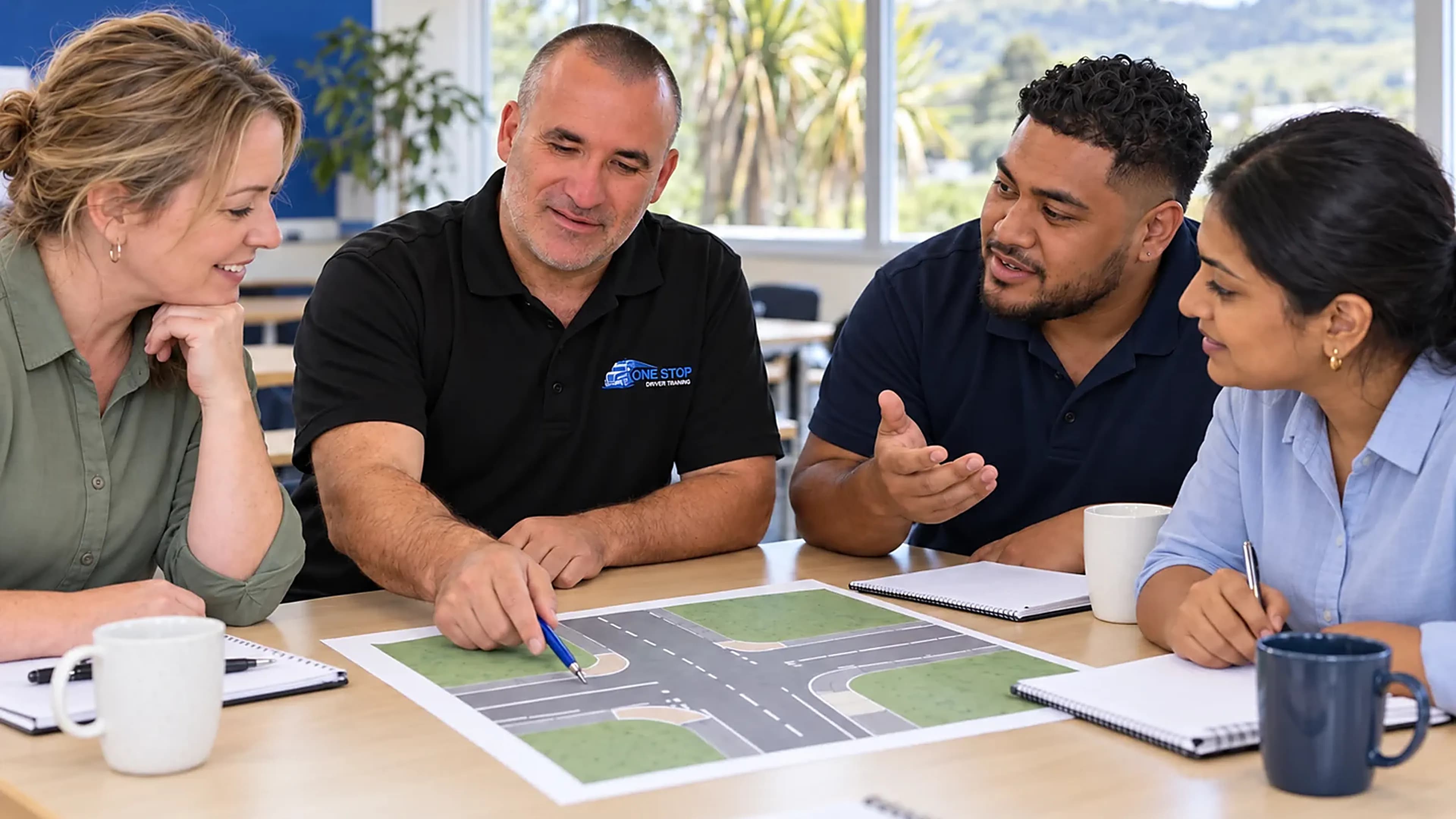
Council teams drive and operate a wide mix of vehicles. Parks crews use utes and machinery, depots run forklifts, and roading and waste teams drive trucks. Each comes with its own licence class or endorsement, and some come with expiry dates that are easy to miss.
This guide is for fleet, roading, parks, waste and facilities managers in Palmerston North, Manawatū, Horowhenua and Kāpiti. It maps common roles to training, lists the records worth keeping and explains how to brief One Stop. One Stop’s owner and trainer, Steve Wilkinson, is a Competenz-registered forklift trainer and a registered Connexis assessor for wheels, tracks and rollers.
Which training fits each council role?
Start with the vehicle or machine, not the job title. The licence class depends on the vehicle’s loaded weight. Endorsements depend on the machine and where it’s driven. Use the table as a starting point for planning.
Check each vehicle’s weight before you book. Vehicles over 3,500 kg have a certificate of loading, usually on the front windscreen, showing the GVM or GCM. Don’t use the empty (tare) weight or the RUC licence weight. Class 2 also covers rigid trucks with two axles or fewer over 18,000 kg.
| Role | Vehicle or machine | Licence or endorsement | One Stop course |
|---|---|---|---|
| Pool-vehicle drivers | Cars and utes, 6,000 kg or less | Full Class 1 car licence | Driver development lessons and VR driver training |
| Roading and waste truck drivers | Rigid trucks, 6,001 to 18,000 kg loaded | Class 2 | Class 2 truck licence |
| Heavy truck drivers | Rigid trucks over 18,000 kg loaded | Class 4 | Class 4 truck licence |
| Truck and trailer drivers | Combinations over 25,000 kg loaded | Class 5 | Class 5 truck licence |
| Operators of wheeled machines | Loaders, graders and similar roadworks machines | W, plus the licence class for the weight and speed | Wheels, tracks and rollers |
| Operators of tracked machines | Diggers and dozers | T, plus full Class 1 up to 18,000 kg or Class 2 over | Wheels, tracks and rollers |
| Roller operators | Rollers | R, plus full Class 1 up to 18,000 kg or Class 2 over | Wheels, tracks and rollers |
| Depot and store staff | Forklifts | Operator certificate, plus F to drive on a road | Forklift training, with or without F |
| Staff carrying hazardous substances | Any vehicle with dangerous goods aboard | D, where the load requires it | Dangerous goods course |
Source: NZTA: Driver licence classes and what you can drive · NZTA: Applying for an R, T or W endorsement for special-type vehicles · NZTA: Applying for a forklift F endorsement · NZTA: Applying for a dangerous goods D endorsement
Driver development and VR for pool-vehicle drivers
Pool-vehicle drivers already hold a licence, so the aim is safer habits, not a new licence. One Stop’s organisations page invites councils to discuss driver development and VR training. Talk to the team about one-to-one sessions on the road, VR sessions, or a mix of both.
On-road sessions are one hour, one-to-one, in One Stop’s car or your own vehicle with a current WoF. VR sessions run for about an hour each, with 10 recommended, and explore driving scenarios and hazards in a virtual setting. VR complements awareness and decision-making practice. It doesn’t replace practical driving experience.
Check newer staff’s licence stage too. A learner or restricted Class 1 licence covers vehicles of 4,500 kg or less, within the licence conditions. A full Class 1 covers vehicles and combinations up to 6,000 kg.
Source: NZTA: Driver licence classes and what you can drive
Planning your training? Plan team training and check the options for your next step.
What do council truck drivers need?
Truck drivers need the class for the truck’s loaded weight: Class 2 for rigid trucks of 6,001 to 18,000 kg, Class 4 for rigid trucks over 18,000 kg and Class 5 for combinations over 25,000 kg. One Stop runs approved Class 2, 4 and 5 courses. For Class 3, ask the team.
Each course runs over up to 3 days: a logbook day on unit standard 24089, a class day and a practical assessment. The course certificate replaces the practical test, so there’s no 6-month learner wait. Each driver needs the learner licence for that class first, plus a heavy vehicle medical certificate unless they’ve given one in the last five years.
Drivers can train in One Stop’s truck or a council truck. A council truck must carry at least 50% of its payload with suitable restraints, and the team checks it before a place is confirmed. Class 2 is $1,400.00 in One Stop’s truck or $1,150.00 in your own, including GST and the logbook day.
What do roading and parks machine operators need?
Operators need an endorsement to drive a special-type machine on a road: W for wheeled machines, T for machines on self-laying tracks and R for rollers. The course certificate alone isn’t enough. The endorsement must be on the operator’s licence.
The licence class still applies. Tracked and roller machines up to 18,000 kg need a full Class 1, and heavier ones need Class 2. Wheeled machines up to 6,000 kg, or up to 18,000 kg at 40 km/h or less, need Class 1. Heavier or faster ones need Class 2, or Class 4 if they’re over 18,000 kg and travel faster than 40 km/h.
W doesn’t cover tractors, forklifts, passenger vehicles, fire engines, trade vehicles or vehicle recovery vehicles. One Stop’s course is a theory and practical assessment, with unit standards 16701 (wheels), 16703 (tracks) and 16702 (rollers). Operators need a current full Class 1 licence and can do one, two or all three. Worksite training is available on request.
Source: NZTA: Applying for an R, T or W endorsement for special-type vehicles
What do depot staff need for forklifts?
Depot staff who use a forklift at work need operator training. If they drive it on a road, they need the F endorsement too. NZTA defines a road broadly, as any place the public has access to, and says even a factory yard with no gate may count. Check how your depot is set up.
Class 1 with F covers forklifts up to 18,000 kg loaded, and heavier forklifts need Class 2 with F. F expires on the same date as the driver licence. For the operator certificate, WorkSafe’s code recommends a refresher every three years.
One Stop offers operator training (about 5 hours), operator training and F (about 5.5 hours, needs a full Class 1), a refresher (about 5 hours, needs a current certificate with evidence) and F only. Training can run at your depot for groups of four or more.
Source: NZTA: Applying for a forklift F endorsement · WorkSafe: Forklift training
Who needs a dangerous goods D endorsement?
Anyone carrying dangerous goods for hire or direct reward needs a current D endorsement, for any amount. For goods carried as tools of trade for agricultural or commercial work, D is needed once loads are over the Schedule 1 limits of Land Transport Rule: Dangerous Goods 2005, with exceptions in clause 9.2. Domestic or recreational use doesn’t need D.
Not sure where your team’s fuel or chemical loads sit? NZTA answers questions on 0800 822 422. Ask before you book, so only the staff who need D do the course.
One Stop’s course is one day of theory with materials provided, as an initial assessment or a refresher. Staff need at least a Class 1 learner licence, and they must read, write and understand spoken English, because interpreters can’t be used. Courses are listed for Palmerston North, Levin, Kāpiti and Wellington.
What records should a council keep?
Keep one record per person with their licence classes and expiry date, each endorsement and its expiry, and the certificates behind them. The dates don’t line up: a D endorsement lasts five years, while F, R, T and W expire on the same date as the driver licence.
A licence card shows an L after any class held at learner level, such as 2L. NZTA sends a reminder about six weeks before a D endorsement expires, but book the refresher earlier, as it needs a current certificate. After a D course, apply promptly: the course certificate must be no more than 60 days old.
A course certificate alone doesn’t let anyone drive the machine on a road or carry the goods. The endorsement has to be on the licence.
| Record | What to keep | When it’s due |
|---|---|---|
| Driver licence | Classes held, including any learner (L) classes | The licence expiry date |
| D endorsement | Course certificate and endorsement date | Every 5 years, after another course |
| F endorsement | Course certificate and licence class | With the driver licence |
| R, T and W endorsements | Which letters each operator holds | With the driver licence |
| Forklift operator certificate | Certificate of Competency | A refresher every 3 years, as WorkSafe’s code recommends |
| Truck course certificates | Class and logbook (24089) certificates | Keep them: a 24089 from the last 12 months may skip the logbook day on Class 4 or 5 |
Source: NZTA: Driver licence classes and what you can drive · NZTA: Applying for a dangerous goods D endorsement · NZTA Factsheet 37: D endorsements · NZTA: Applying for a forklift F endorsement · NZTA: Applying for an R, T or W endorsement for special-type vehicles · WorkSafe: Forklift training
How do you brief One Stop on a council programme?
Send one brief covering numbers, sites, machines and dates. For each group, say how many people, which vehicles or machines they use, what they already hold and what they need. Forklift training can run onsite for groups of four or more, and WTR worksite training is available on request.
Use the enquiry form on the organisations page. No payment or account is needed. The team talks through suitability, location and scheduling, then confirms scope, pricing and arrangements before you commit. Travel fees may apply outside One Stop’s area. Include:
- The number of staff in each role, and who needs initial training or a refresher
- Sites: depots, yards or worksites around Palmerston North, Manawatū, Horowhenua or Kāpiti
- Machines and vehicles, with loaded weights for trucks and heavy machines
- Current licences and endorsements, with expiry dates
- Preferred dates, and any times crews can’t be released
- A contact person for the programme
What do the workplace courses cost?
One Stop’s course prices are per person and include GST. NZTA fees are separate and paid at the licensing agent: $62.10 for each new F, R, T or W endorsement and $20.70 for a new D endorsement. Onsite and group arrangements are confirmed with your quote.
| Course | Price incl. GST | NZTA fee |
|---|---|---|
| Wheels, tracks and rollers, all three | $360.00 | $186.30 (3 × $62.10) |
| Wheels (W) | $207.00 | $62.10 |
| Tracks (T) | $207.00 | $62.10 |
| Rollers (R) | $207.00 | $62.10 |
| Forklift operator training | $260.00 | No NZTA fee |
| Forklift operator training and F | $330.00 | $62.10 |
| Forklift operator refresher | $230.00 | No NZTA fee |
| F endorsement only | $120.00 | $62.10 |
| Dangerous goods initial assessment | $350.00 | $20.70 |
| Dangerous goods refresher | $300.00 | Paid at the agent when you apply again |
Source: NZTA: Applying for an R, T or W endorsement for special-type vehicles · NZTA: Applying for a forklift F endorsement · NZTA: Applying for a dangerous goods D endorsement
Common questions
Can One Stop train council staff at a depot or worksite?
Yes, for some courses. Forklift training can run onsite for groups of four or more, and WTR worksite training is available on request. Send the site, numbers, machines and dates, and the team confirms what can be arranged.
Does the W endorsement cover a parks tractor?
No. W doesn’t cover tractors. It doesn’t cover forklifts either; they need the F endorsement.
Source: NZTA: Applying for an R, T or W endorsement for special-type vehicles
How often does a D endorsement need renewing?
Every five years. Each renewal needs another approved course, then a new application at a licensing agent.
Can staff on a restricted licence drive pool utes?
Only vehicles of 4,500 kg or less, and only within their licence conditions. A full Class 1 licence covers vehicles up to 6,000 kg.
Is the WTR course certificate enough to drive a roller on the road?
No. Take the certificate to AA or VTNZ with a DL19 form and ID, pass the eyesight check and pay $62.10 per endorsement. The operator is covered once R is on their licence.
Source: NZTA: Applying for an R, T or W endorsement for special-type vehicles
Sources and further reading
- NZTA: Driver licence classes and what you can drive
- NZTA: Applying for an R, T or W endorsement for special-type vehicles
- NZTA: Applying for a forklift F endorsement
- WorkSafe: Forklift training
- NZTA: Applying for a dangerous goods D endorsement
- NZTA Factsheet 37: D endorsements
Check the linked official guidance when planning an application or test. A training booking is separate from applying for a licence.