Licences & work
NZ driver licence classes 1 to 5: which truck can you drive?
New Zealand’s car and truck licences run from Class 1 to Class 5. Class 1 covers vehicles up to 6,000 kg, Class 2 medium rigid trucks of 6,001 to 18,000 kg, Class 3 medium combinations of 12,001 to 25,000 kg, Class 4 heavy rigid trucks over 18,000 kg and Class 5 heavy combinations over 25,000 kg. Most drivers move up 1, 2, 4, 5, holding each full licence for at least 6 months before the next (3 months for the later heavy classes if you’re 25 or over).
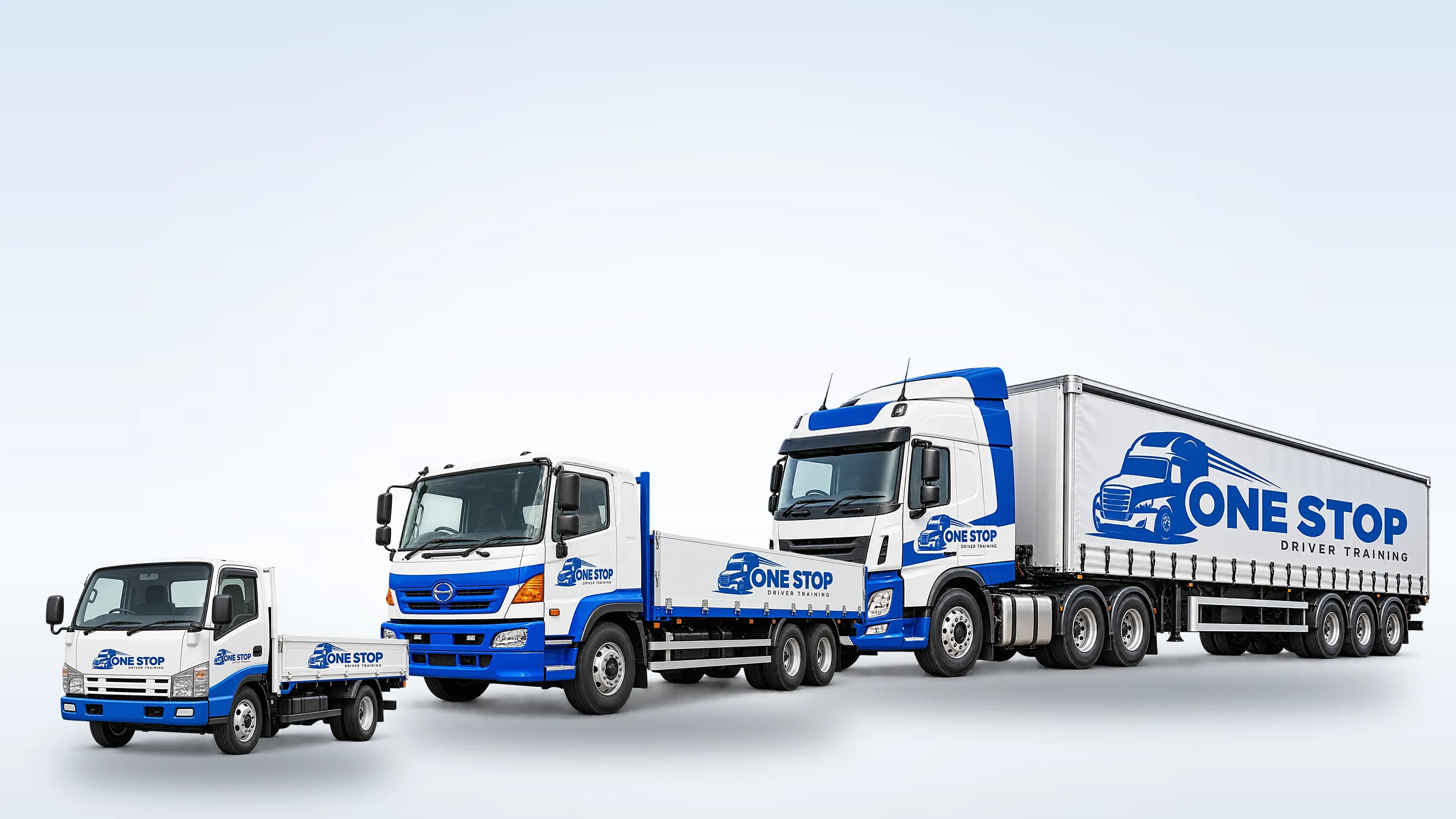
A Class 1 licence in NZ is your car licence. The truck classes start at Class 2, and each one depends on the vehicle’s weight and on any trailer it tows.
This guide shows what each class lets you drive, how to find the weight that counts, and the order you move through the classes. The rules come from NZTA and were checked on 11 November 2026. One Stop runs Class 2, 4 and 5 courses for drivers in Palmerston North, Levin and Kāpiti, and the venue and dates are confirmed when you book.
What does each NZ licence class let you drive?
Each licence class is set by vehicle type and weight. A rigid vehicle is a single truck on its own. A combination is a vehicle plus the trailer it tows, weighed together. NZTA uses gross laden weight (GLW) for rigid vehicles and gross combined weight (GCW) for combinations.
Higher classes include most of the lower ones, with one gap. Class 4 covers Classes 1 and 2, but not Class 3. Class 5 covers everything from Class 1 to Class 4. Class 6 is the motorcycle licence and sits outside the truck classes.
| Class | Name | What you can drive | Also covers |
|---|---|---|---|
| Class 1 | Car licence | Any vehicle or combination up to 6,000 kg, except motorcycles | No other class |
| Class 2 | Medium rigid | Rigid vehicles of 6,001 to 18,000 kg, combinations up to 12,000 kg (not a tractor and trailer), and rigid vehicles over 18,000 kg with two axles or fewer | Class 1 |
| Class 3 | Medium combination | Combination vehicles of 12,001 to 25,000 kg | Classes 1 and 2 |
| Class 4 | Heavy rigid | Rigid vehicles over 18,000 kg, including tractors | Classes 1 and 2, but not Class 3 |
| Class 5 | Heavy combination | Combination vehicles over 25,000 kg | Classes 1, 2, 3 and 4 |
What can you drive on a Class 1 licence in NZ?
A full Class 1 licence covers any vehicle or combination weighing 6,000 kg or less, including tractors, but not motorcycles. On a learner or restricted Class 1 licence, the limit is lower: 4,500 kg or less.
A full Class 1 also covers two heavier cases. You can drive a zero-emission vehicle of 6,001 to 7,500 kg. You can also drive a tractor of 6,001 to 18,000 kg if you drive it at 40 km/h or less. Most other vehicles over 6,000 kg need a heavy licence class.
To start on trucks, you need to have held your full Class 1 for at least 6 months. That lets you apply for the Class 2 learner licence, which comes with a theory test. On your licence card, an “L” after a class number, such as 2L, means you hold the learner licence for that class.
Source: NZTA: What you can drive with each licence class · NZTA: Heavy vehicle learner licence (stage 1)
Planning your training? Choose class 2 training and check the options for your next step.
How do you check a truck’s weight for your licence class?
Use the certificate of loading. Vehicles over 3,500 kg have one, usually on the front windscreen. It shows the gross vehicle mass (GVM) and gross combined mass (GCM). These are normally the same as the GLW and GCW figures that decide your licence class.
Don’t go by the unladen or tare weight, or by the weight on the road user charges (RUC) licence. Neither one tells you the licence class. A truck that weighs 5 tonnes empty can still need Class 2 if its certificate shows a GVM over 6,000 kg. Here’s a quick check:
- Find the certificate of loading, usually on the front windscreen.
- Read the GVM for a rigid truck, or the GCM for a combination.
- Match that number to the class table above.
- If you’ll tow a trailer, check if it’s a light trailer (see below).
In what order do you get a heavy vehicle licence in NZ?
Most drivers move up in this order: Class 1, then Class 2, then Class 4, then Class 5. Class 3 is a side branch for medium combinations. You can apply for it once you hold a full Class 2, but you don’t need it to reach Class 4 or Class 5.
Each step starts with a learner licence for the new class, and three of the four heavy classes have a theory test.
| Learner licence | You need first | Theory test |
|---|---|---|
| Class 2 | Full Class 1 held for 6 months | Yes |
| Class 3 | Full Class 2 held for 6 months (3 if you’re 25 or over) | Yes |
| Class 4 | Full Class 2 held for 6 months (3 if you’re 25 or over) | No |
| Class 5 | Full Class 4 held for 6 months (3 if you’re 25 or over) | Yes, unless you’ve passed the Class 3 theory test |
How long do you wait between licence classes?
There are two waits to plan for. The first is time on your full licence before you can apply for the next learner licence. That’s 6 months, or 3 months for Classes 3, 4 and 5 if you’re 25 or over. The second is time on the learner licence before you can get the full licence.
An approved course removes the second wait. With an approved course for Class 2, 3, 4 or 5, you don’t need to hold the learner licence for 6 months, and you don’t sit the practical test. Without one, you practise under supervision for at least 6 months and then sit the practical test.
If you’re 25 or over and complete an approved “accelerated over 25” course, the 3-month wait between classes doesn’t apply. Without that course, a 30-year-old with a full Class 2 could apply for a Class 4 learner licence after 3 months, finish an approved Class 4 course, and then wait 3 months on the full Class 4 before applying for Class 5 learner.
Can you tow a trailer on a Class 2 or Class 4 licence?
Yes, a light trailer. A light trailer has a GLW of 3,500 kg or less. On a Class 2 or Class 4 licence, you can tow one behind your rigid truck, and you don’t count it in the combined weight.
On Class 2, the rigid truck itself must have a GLW of 18,000 kg or less, and it can’t be a tractor. On Class 4, the rigid truck can be over 18,000 kg.
A heavier trailer does count, and then the combined weight decides the class. Up to 12,000 kg is Class 2. From 12,001 to 25,000 kg is Class 3. Over 25,000 kg is Class 5. That’s why Class 5, not Class 4, is the licence for heavy trucks and trailers.
Which One Stop course fits each class?
One Stop runs courses for Class 2, Class 4 and Class 5 on the approved course route, so your course certificate replaces the practical test. There’s no Class 3 course listed, so ask the team if that’s the class you need.
You need the learner licence for the class before the course starts, and One Stop can help you get it for an extra cost. The Class 2 course with a One Stop truck is $1,400.00, including GST and the logbook day. Each course runs over up to 3 days:
- Logbook day: at least 7 hours on fatigue, work time and logbooks (unit standard 24089).
- Class day: at least 5 hours of training and theory for your class.
- Practical assessment: arranged with the team, and sometimes on day two.
- Afterwards: take your certificate and ID to a licensing agent to apply for the full licence.
Common questions
Is a Class 1 licence the same as a car licence?
Yes. Class 1 is the car licence. A full Class 1 covers any vehicle or combination up to 6,000 kg, including tractors but not motorcycles. On a learner or restricted Class 1, the limit is 4,500 kg.
Can I drive a Class 3 vehicle with a Class 4 licence?
No. Class 4 covers heavy rigid trucks over 18,000 kg and everything in Classes 1 and 2, but not Class 3 medium combinations. To drive a combination of 12,001 to 25,000 kg, you need Class 3 or Class 5.
Do I need Class 3 before Class 5?
No. The Class 5 learner licence needs a full Class 4 held for 6 months, or 3 months if you’re 25 or over. A full Class 5 then covers Class 3 vehicles as well, so you never need to sit Class 3 on the way.
Source: NZTA: Heavy vehicle learner licence (stage 1) · NZTA: What you can drive with each licence class
Which weight do I use to work out my licence class?
Use the GVM or GCM on the certificate of loading, which is usually on the front windscreen of any vehicle over 3,500 kg. Don’t use the unladen or tare weight, or the weight on the RUC licence.
Sources and further reading
Check the linked official guidance when planning an application or test. A training booking is separate from applying for a licence.